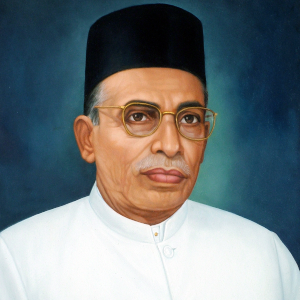
The story begins with him. Born in Cambay in 1893, Hiralal Bapulal Kapadia was a man of rare intellectual range who turned away from a contemplative life and chose instead to pour that same depth of spirit into the classroom. In 1926, he founded The New High School — the seed from which everything that followed would grow.
His mastery of both English and Sanskrit was unusual for the era, and spoke to a mind that refused to treat knowledge as compartmentalised. The ancient and the contemporary, the rigorous and the humane — he held them together with ease. Those who knew him spoke of his devotion, his purity of intention, and an unshakeable belief that teaching was not a profession but a form of service.
It was this founding spirit — quiet, principled, and deeply sincere — that gave the institution its earliest character, and whose influence, nearly a century on, still runs through everything the school stands for.
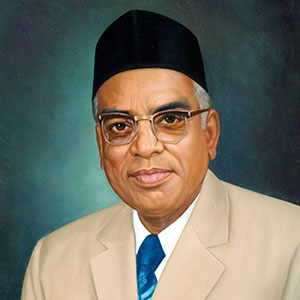
The school carries his name, and rightly so. Born in 1919 in Vatra Village near Cambay, Ramanlal Hiralal Kapadia grew into the defining figure of the institution — the youngest principal of his generation, and one of the most admired educators of his time in Gujarat.
His command of the English language was spoken of with quiet awe by all who encountered him. His insistence on discipline — on doing things properly, completely, without compromise — earned equal respect. He was said to write on the blackboard with both hands simultaneously, a small and almost legendary detail that somehow captures everything about the quality of his extraordinary mind.
Beyond the school's walls, R.H. Kapadia shaped the wider educational landscape of Gujarat. As president and secretary of the Ahmedabad Secondary Schools and Headmasters' Associations, and as a member of the Gujarat State Federation of School Management's executive committee, he brought the same standards he held within his own corridors to the broader cause of education across the state. His was a legacy built not in isolation, but in service of an entire generation of learners.
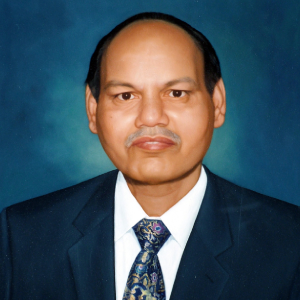
Son of R.H. Kapadia and a distinguished educator in his own right, Rajnikant Ramanlal Kapadia was the third pillar of the school's founding story. Born in Cambay in 1940, he built a reputation as a meticulous and gifted teacher of English prose and grammar — a subject he approached with the same care his father had brought to the institution as a whole.
He served as president of the Gujarat Acharya Sangh for three consecutive terms, a measure of the deep professional respect his peers held for him. Yet those within the school remember him differently: not for positions or recognitions, but for the quality of his presence.
He was not a man of spectacle. He was a man of constancy — a quiet, principled figure whose steady hand guided the school through the years he walked its corridors, ensuring that what his father and grandfather had built would continue to grow, and would not lose its essential nature in doing so.